A ten-year restoration, and a centenary
Back on the main line in 2016, and still steaming after its 100th birthday.
How this site works. Every fact is in our own words and linked to its source, beside it. Where good sources disagree, we show each version in a “Sources differ” box.
The restoration
From 2006 it went through a long restoration in the workshop of Riley & Son (E) Ltd. NRM
The work was meant to finish in 2011 but was delayed when cracks were found in the chassis. BBC, 2016
Riley and Sons of Bury, Greater Manchester, were appointed in 2013 to finish the job. BBC, 2016
More work than expected was needed on some parts, and a tight deadline to meet the first run, which pushed the cost up. NRM, 2016
What did the restoration cost? Sources differ
- The project was completed in 2016, with the locomotive in BR Green as 60103, at a cost given as £4.2m. NRM
- In September 2016 the National Railway Museum put the full and final cost of the restoration at £4,537,892. NRM, 2016
£4.2m was the estimate in 2015 and is the figure the museum’s history page still gives. The museum’s own final figure, announced in September 2016, was higher.
Back on the main line, 2016
Still in black paint, it made test runs in Lancashire and Cumbria in January and February 2016. BBC, 2016
It took 10 days to strip off the black paint and repaint it green. BBC, 2016
In February 2016 it made its first run back, from London King’s Cross to the National Railway Museum in York, pulling 11 carriages. NRM blog, 2016
That first run, between London and York, was set for 25 February 2016, its first official outing with its nameplates and new colours. BBC, 2016
Tens of thousands of people lined platforms and bridges to watch. NRM blog, 2016
It arrived at Platform 9 in York at around 12.30pm. NRM blog, 2016
Over 200,000 people saw it in 2016 at York, Shildon and heritage railway events after its return. NRM, 2016
It came top of a YouGov poll of the world’s most famous locomotive, ahead of Stephenson’s Rocket. NRM blog, 2016
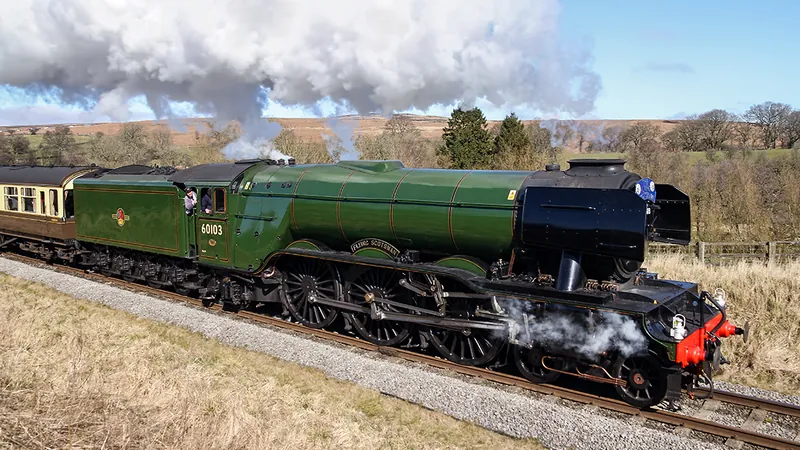
100 years, 2023
The National Railway Museum celebrated its 100th birthday on 24 February 2023. NRM, 2023
On 12 June 2023, in its centenary year, it hauled the Royal Train into Pickering, with King Charles III aboard, on the North Yorkshire Moors Railway. NRM, 2023
For the Royal Train its roof was painted white and new lamps were fitted to the cab. NRM, 2023
It had last hauled a Royal Train on 20 November 1984, carrying the Queen Mother to North Woolwich, where she opened a small railway museum. NRM, 2023 Told when Scotsman was built, the Queen Mother replied that it was the year she was married. NRM, 2023
For the centenary the Royal Mint made a £2 coin showing Flying Scotsman in colour. NRM, 2023
Michael Morpurgo wrote a children’s book for the centenary: Flying Scotsman and the Best Birthday Ever. NRM, 2023
Poet laureate Simon Armitage read a new poem, The Making Of The Flying Scotsman, at Edinburgh Waverley for its 100th anniversary. BBC, 2023
A National Railway Museum curator calls it a ‘memory machine’. NRM blog, 2023
Who looks after it
Today it is owned by the National Railway Museum in York, and operated and maintained by Riley & Son (E) Ltd of Heywood, Greater Manchester. NRM, 2023
Like all working steam locomotives, it has winter maintenance every year. NRM, 2016
The National Railway Museum in York has the largest collection of railway objects in the world, with over 260 locomotives and rolling stock. NRM, 2023
Entry to the National Railway Museum is free. NRM
Flying Scotsman travels, so check the National Railway Museum’s own pages before a visit. For more heritage steam, the Isle of Man’s railways are on manx.railways.im, and if you want a Flying Scotsman of your own, model.railways.im explains scale and gauge before you buy a model.
Next: myths →